
You changed your protocol. Did it actually work?
Symptune turns a 20-second daily check-in into before/after answers: whether your dose change moved anything, whether your pre-injection dip is real, and what to show your doctor when labs say "normal."
Daily tracking is free forever. No credit card. 20 seconds a day.
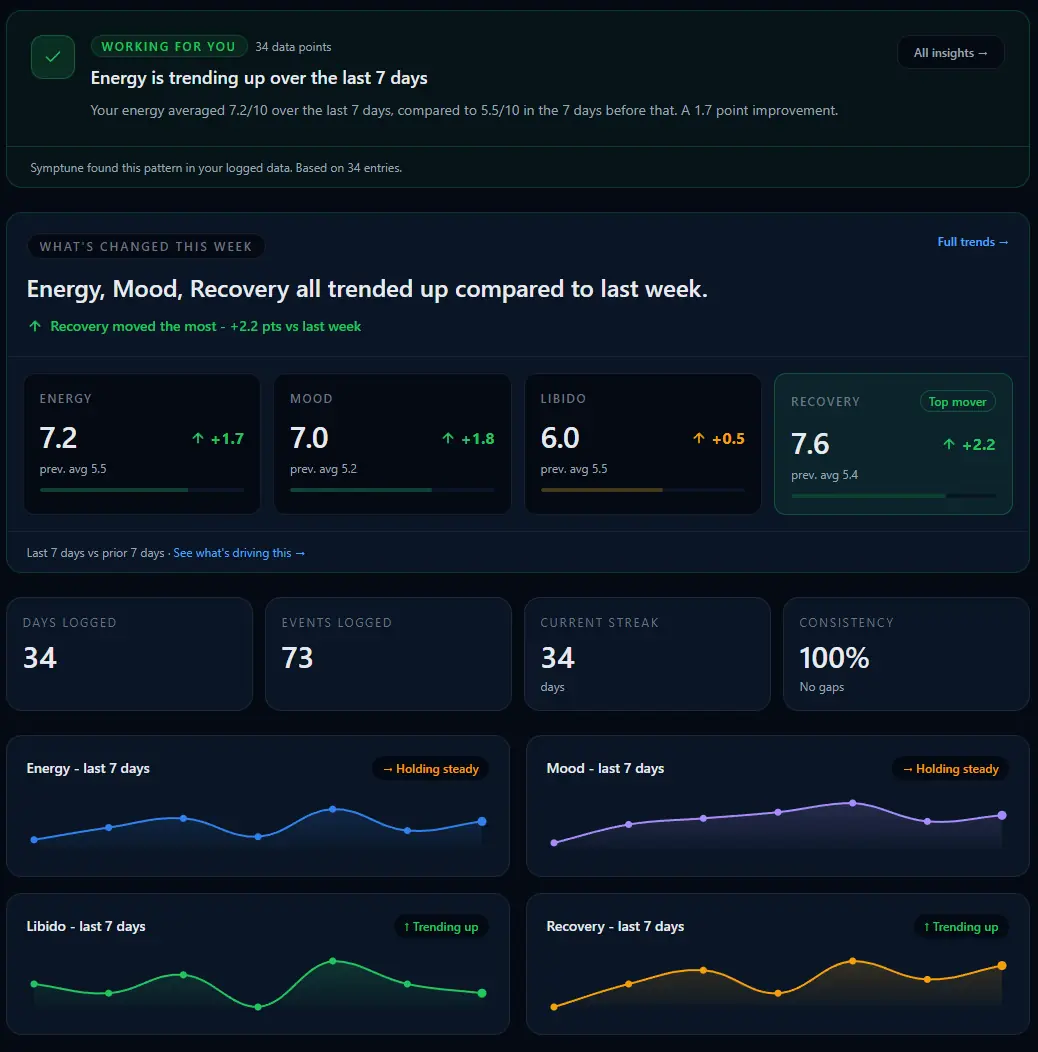
Actual Symptune dashboard, shown with illustrative account data.
The input
What you changed
Dose, timing, supplements, sleep shifts -- each with a date and context.
The signal
How you felt after
Same metrics tracked daily so the trend becomes visible over time.
The pattern
31 days of dataWhat moved alongside it
AM timing and consistent sleep appear before 3 of 4 best energy weeks.
Everything is logged somewhere. Nothing has context.
Dose timing, sleep, supplements, training, labs, and daily state usually live in separate places. The missing layer is sequence: what changed first, what followed, and what kept repeating.
Protocol
Dose timing
Critical context, but usually separated from how you felt before and after.
State
Daily check-ins
Energy, libido, mood, sleep, and recovery are useful only when tracked consistently.
Routine
Lifestyle changes
Training, sleep, supplements, diet, caffeine, and schedule shifts can hide or mimic protocol effects.
Missing layer
Sequence
The order of events is what turns disconnected logs into useful patterns.
Example insight
Based on repeated check-ins over time
Energy appears more stable when dose timing and sleep remain consistent.
Strongest input
Sleep consistency
Secondary
Dose timing
Limited
One-off changes
The answer is in your data. You just need enough of it.
Symptune is not trying to replace your doctor or tell you what to take. It gives you a clearer view of your own sequence of events so decisions can be reviewed with more context.
Who this is for
Built for the good weeks, the bad weeks, and the ones you can't explain.
Symptune is most valuable when you have a stable baseline before a change. Start before your next adjustment, so the before period actually exists.
Dialing in TRT
Good week. Bad week. Feel wrecked for no obvious reason. You've adjusted dose timing, frequency, or stacked a supplement. But you can't separate what moved from what didn't.
Track what changes after each adjustment
Running labs without context
Your numbers come back in range but you still feel off. Or they're off and you feel fine. Labs show a moment in time, not what led to it.
Connect labs to your check-in history
Tracking without clarity
You've been logging for weeks. Some protocols work for a while and then stop. Symptune lines up what changed alongside how you felt, so the shift is at least visible.
See what changed before and after each shift
This is what you get, not a concept.
Six real screens from the app. The parts a notes app can't do: trends, pattern detection, and a report you can hand to your doctor.
Screen 1 of 6
Your overview at a glance
Days logged, current streak, consistency, and where each metric is trending, the moment you open the app.
Screen 2 of 6
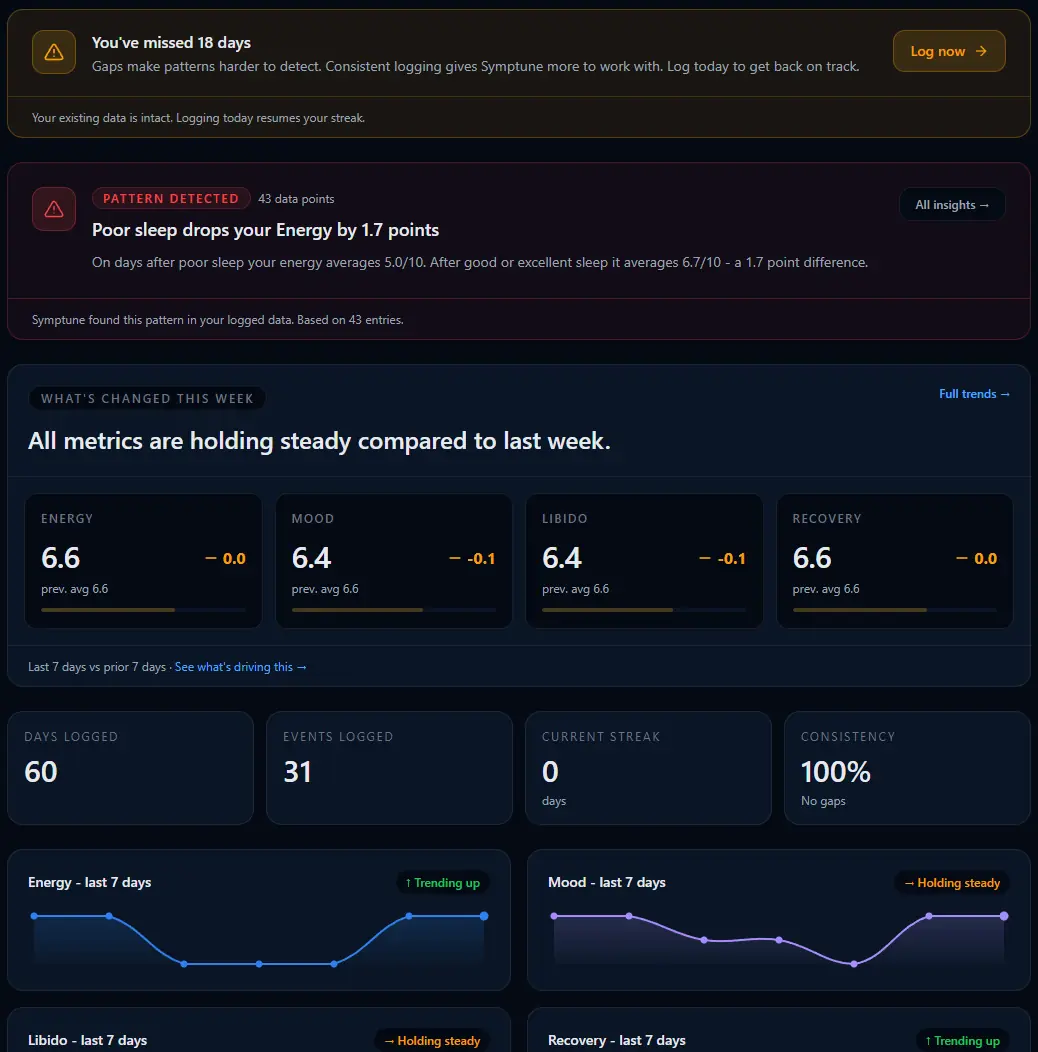
It tells you when the data has gaps
Miss a few days and Symptune says so, because gaps make patterns less reliable. Flagged patterns surface here too.
Screen 3 of 6
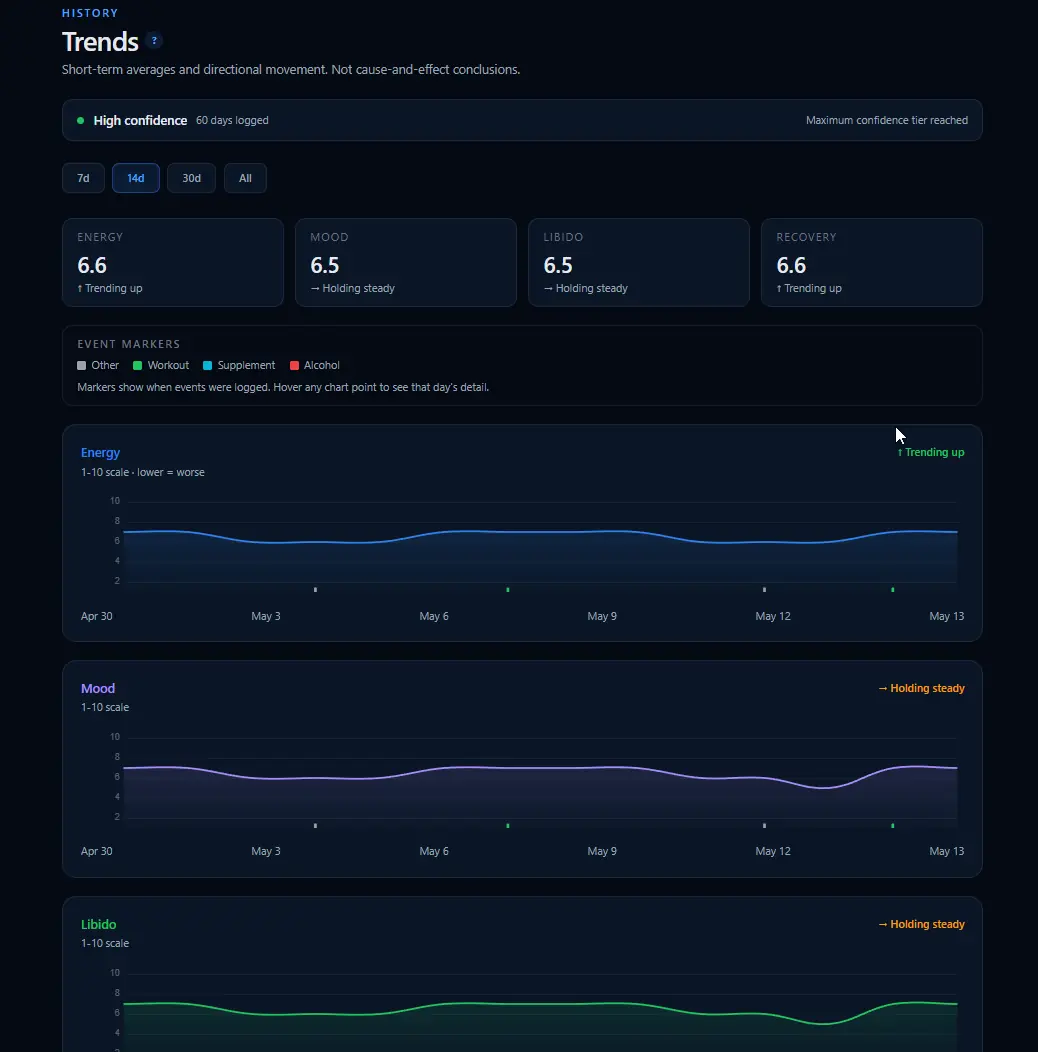
See your trends over time
Short-term averages and directional movement for energy, mood, libido, and recovery. Directional, not cause-and-effect.
Screen 4 of 6
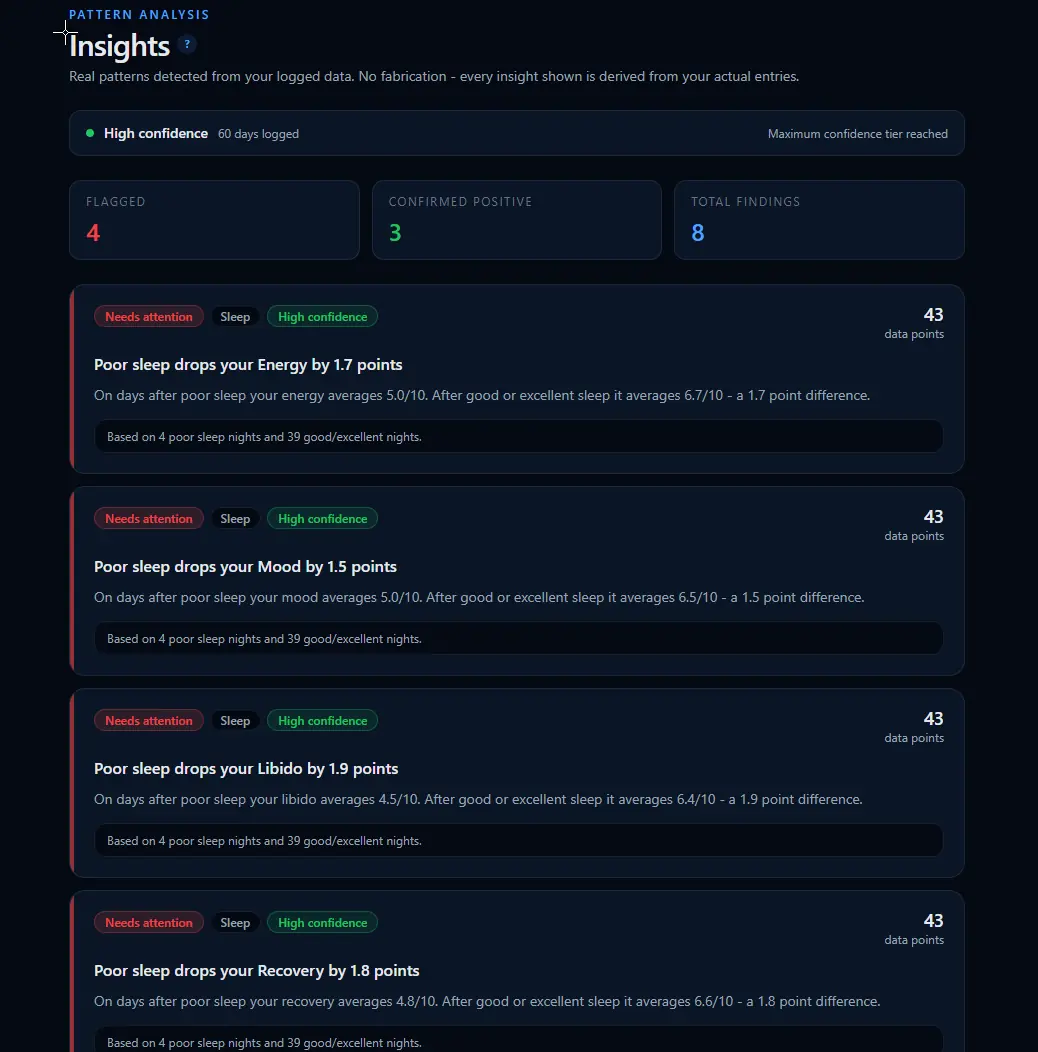
Read patterns, not guesses
Insights are descriptive averages from your own check-ins, filtered by effect size and sample minimums. Anything thin stays hidden.
Screen 5 of 6
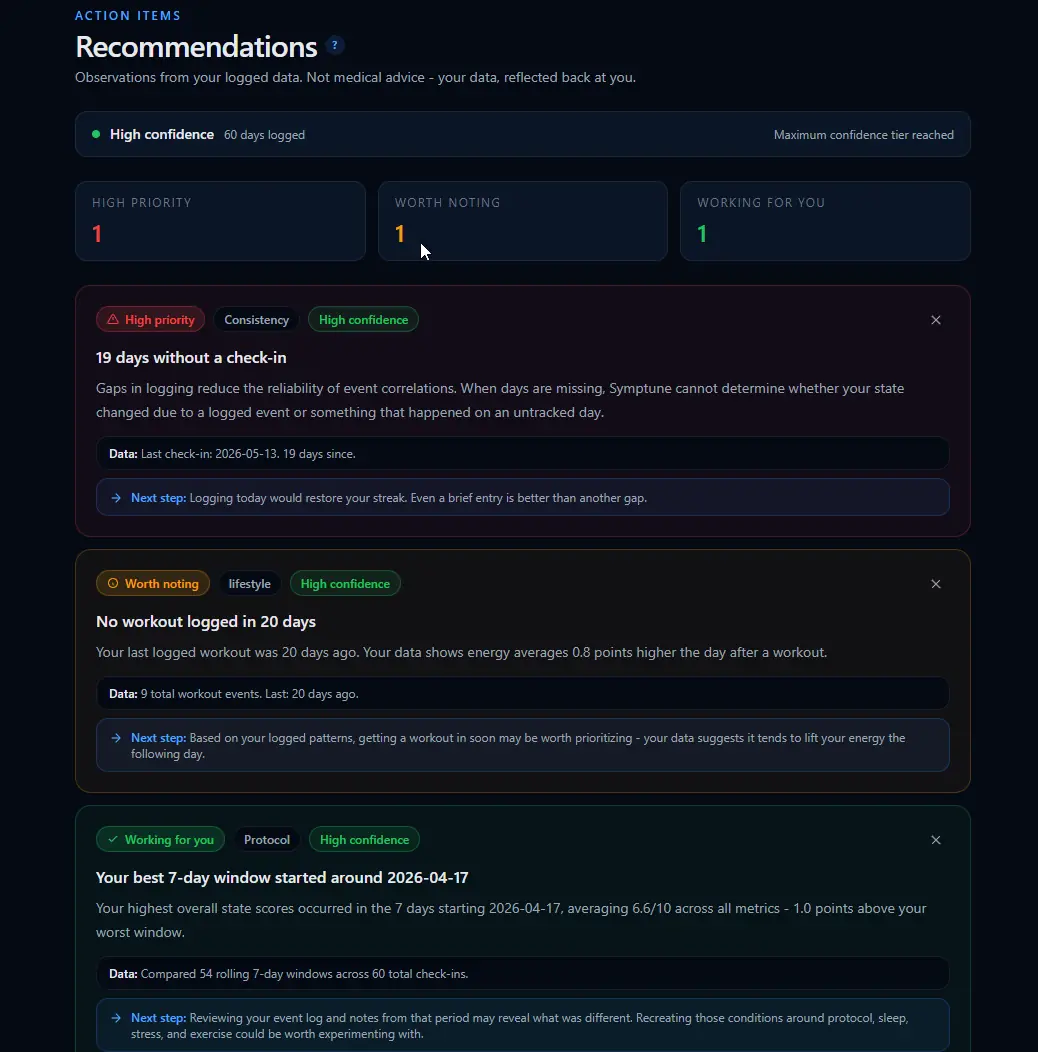
Recommendations grounded in your data
Observations from what you logged, framed as things worth trying. Never medical advice, just your data reflected back.
Screen 6 of 6
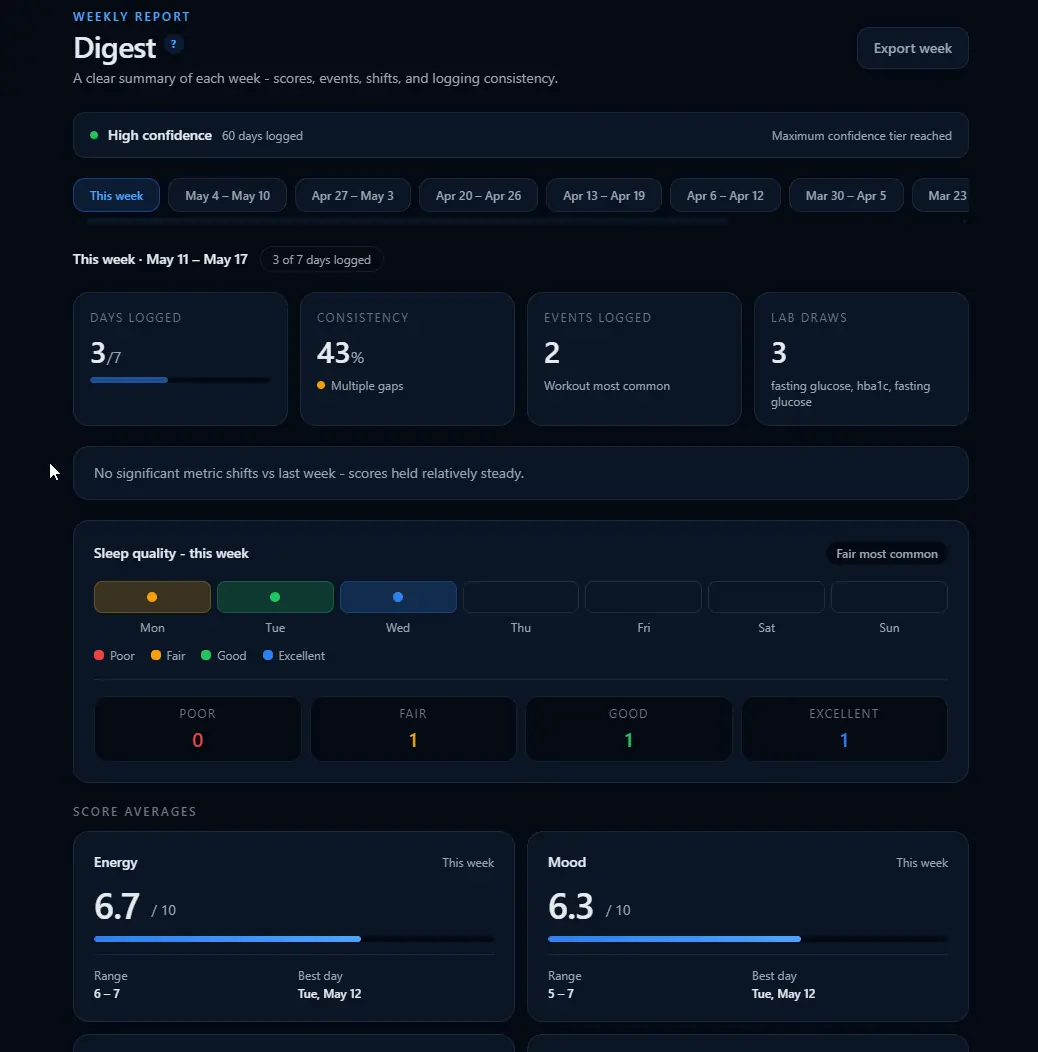
A weekly digest you can export
Each week summarized: scores, events, sleep, and logging consistency, on one page you can hand to your doctor.
Screens shown with illustrative account data.
Built around sequence, not isolated entries.
Symptune organizes what happened, when it happened, and how your daily state changed afterward so each input has context.
The point is not more logging.
The point is seeing which of your changes are consistently associated with feeling better or worse.
Baseline
Create your starting point
Set your protocol status, dose schedule, primary goal, and starting state so future changes have a reference point.
Check-ins
Track the same metrics daily
Log energy, mood, sleep, libido, recovery, dose timing, and meaningful routine changes in one place.
What moved
See what actually changed
As data accumulates, Symptune surfaces which inputs appear before good weeks and which appear before bad ones. No instant diagnosis. No one-time report.
Pattern detection, not diagnosis.
Symptune organizes your personal timeline so protocol inputs, daily state, labs, and lifestyle changes can be reviewed with better context.
Not medical advice
Symptune does not diagnose, treat, prescribe, or replace medical care. It helps organize your data and surface patterns over time.
01
Baseline setup
Your protocol status, dose schedule, goals, and starting state organized clearly.
02
Daily check-ins
Energy, sleep, mood, libido, and recovery rated daily. The consistent signal that makes everything else possible.
03
Tracking focus
A short list of things to focus on first, so you start clean.
04
Pattern feedback
Which inputs move which outcomes. What improved. What didn't. Built from your data, not guesswork.
Track for free. Pay only for deeper analysis.
Daily tracking is free forever. Once you have about three weeks of data, the heavier pattern analysis becomes available on Pro.
Free forever
$0
No credit card required.
- Baseline setup
- Daily check-ins, forever
- Events and protocol history
- Basic trends and progress
- Data export anytime
Pro
$24
/month
Or $240/year. Cancel anytime.
- Everything in Free, plus:
- Input correlations across your metrics
- Before/after protocol comparisons
- Injection-cycle analysis
- Recommendations grounded in your data
- Confounder-aware experiments
- One-page clinic report
You never hit a paywall while you are still building data. Pro only matters once there is enough to analyze.
Questions worth answering before you start.
Symptune surfaces real patterns from your actual data. It does not diagnose, prescribe, or replace clinical care.
Will this actually tell me something useful?
Only if you log consistently. Symptune runs real arithmetic on your actual check-ins - it never fabricates conclusions. Early trends appear once you have about a week of data, and deeper patterns like input correlations and before/after comparisons surface as you log more. Every insight shows the sample size it came from, and anything with too little data behind it stays hidden.
What's free, and what costs money?
Daily tracking, events, basic trends, and export are free forever, no card. The deeper analysis (input correlations, before/after protocol comparisons, cycle analysis, and the clinic report) is part of Pro, at $24/month or $240/year. You only reach that choice once you have about three weeks of data, so nothing is gated while you are still building signal.
My doctor says my labs are normal but I still feel off. Does this help?
This is exactly what Symptune is built for. Labs show a single moment in time. Symptune shows what your daily state looked like in the weeks before and after that draw - and how it shifted across protocol changes. The clinic report (a Pro feature) puts all of it on one page your doctor can actually read.
Is this medical advice?
No. Symptune organizes your data and surfaces patterns so you can review changes with better context - including with your clinician. It does not diagnose, treat, or prescribe. What it does is give you something concrete to bring to an appointment instead of trying to remember how you felt three weeks ago.
You changed something. See what moved with it.
Your protocol changes deserve more than memory. Build the record that lets you compare before and after.